 Quayline
A registry built around how builds actually move bytes
Quayline stores container images, language packages and raw build outputs in one place, replicates them to where your runners and clusters are, and keeps the bill and the policy in one file each.
What happens when you push
The path is short on purpose. Every step is visible in the audit log and in the console activity feed.
- Authenticate. The client presents a scoped token or a short-lived OIDC exchange from your CI. Tokens carry repository path prefixes and an expiry, never blanket access.
- Chunk and hash. Blobs are split on content-defined boundaries and addressed by SHA-256. Chunks the cell already holds are skipped, so a rebuild with one changed file uploads kilobytes.
- Commit to the home region. The manifest is written only after every blob is durable on three storage nodes in separate racks. A push either completes or leaves nothing behind.
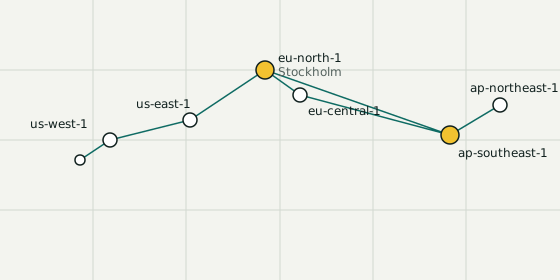
- Replicate. Replication rules copy the artifact to the regions you chose. Median replication lag between eu-north-1 and eu-central-1 is 1.4 seconds for a 100 MB image.
- Evaluate policy. Signature requirements, vulnerability gates and retention rules run against the new artifact, and the result is attached as a referrer you can query.
Formats and what each one supports
| Format | Endpoint | Clients tested in CI | Notable features |
|---|---|---|---|
| OCI images | fi4.enotcloud.com | docker 27, podman 5, containerd 2.0, skopeo, crane, buildx | Referrers API, multi-arch indexes, zstd layers, cross-repository mounts, Helm charts |
| npm | /npm/<org>/ | npm 10 and 11, pnpm 9, yarn 4, bun 1.2 | Scopes, dist-tags, provenance, upstream mirror with 30 day revalidation |
| PyPI | /pypi/<org>/simple/ | pip 24, uv 0.5, poetry 2, twine 6, pdm | PEP 503 and 691, yanking, trusted hash pinning, mirror with quarantine |
| Maven | /maven/<org>/releases | Maven 3.9, Gradle 8, sbt 1.10, Bazel rules_jvm_external | Release and snapshot repositories, virtual repositories, checksums verified on upload |
| Generic | /generic/<org>/<path> | qln, curl, wget, aws-style multipart tools | Objects to 200 GB, resumable chunked upload, range reads, immutable paths |
Go modules and NuGet are on the roadmap for the first half of 2027. If either blocks you, tell us; the order is driven by customer requests.
Six regions, one namespace
Storage cells run in Stockholm, Frankfurt, Ohio, Oregon, Singapore and Tokyo. An artifact has a home region and any number of replicas; clients are routed to the nearest copy by latency, not by a hostname you have to remember.
- Replication is declarative:
replicate: [eu-central-1, us-east-1]in the repository settings. - Pull-through mirrors of public registries live in the region of the first request and are copied to others on demand.
- Scale and Enterprise organisations can pin data to a single jurisdiction. Data residency is enforced for blobs, manifests, logs and cache chunks alike.
Supply chain controls that stay out of the way
Signature policies are enforced at pull time, not as a nightly report. An image that fails policy is never served to a cluster, and the denial names the rule that blocked it.
$ qln policy set tidewater/api --require-signature cosign --issuer ci-main
policy updated: tidewater/api now requires a cosign signature from 1 trusted issuer

$ docker pull fi4.enotcloud.com/tidewater/api:1.9.2-rc1
Error response from daemon: denied: policy "signed-releases" blocked this pull
  reason: no cosign signature found for sha256:19ab04c7e2d5...
help: https://fi4.enotcloud.com/docs/containers.html#signing- SBOMs and attestations are stored as referrers and can be listed with
qln referrers. - Vulnerability gates use a daily-refreshed advisory feed and can block on severity, on fix availability, or on both.
- Audit log records every read of a protected repository, token creation and policy change, and exports to your own object storage every five minutes.
- Encryption is AES-256 at rest with per-organisation keys and TLS 1.3 in transit. Enterprise can supply keys through an external KMS.
Moving in without a flag day
Most teams migrate repository by repository over two to three weeks, with the old registry still serving reads.
$ qln migrate plan --from old-registry --repos "tidewater/*" --format oci,npm
found 212 repositories, 9,408 tags, 6.2 TB
estimated transfer: 6.2 TB at 3.1 Gbit/s, about 4 h 25 min
no name conflicts, 3 tags exceed policy keep-releases (will be flagged)

$ qln migrate run --plan plan-20261104.json --parallel 8
copied 9,408 of 9,408 tags, verified 6.2 TB by digest
Migration reads only what you grant, verifies every blob by digest after the copy, and leaves the source untouched. Engineers on the Scale plan get a named migration engineer for the first month.