 Quayline
Every artifact your CI builds, stored once and served from the nearest region.
Quayline is a private registry for container images, npm, PyPI and Maven packages, and plain build outputs. One endpoint, one set of tokens, one retention policy, and enough included egress per seat that a busy build farm does not turn into a surprise invoice.
Free for up to 3 seats. Press ? for keyboard shortcuts, / to search.
$ docker push fi4.enotcloud.com/tidewater/api:1.9.1The push refers to repository [fi4.enotcloud.com/tidewater/api]a02f6c91d3e8 Layer already exists5f1c9a2e07b4 Layer already existsb81d3e7c40aa 118.4MBe47720b3159c 61.2MB1.9.1: digest: sha256:7c41d0e9a5b2...e09 size: 1789cosign signature and SBOM attached (2 referrers)retention keep-last-20 applies to tidewater/api$ npm publishnpm notice Publishing to https://fi4.enotcloud.com/npm/tidewater/npm notice package: @tidewater/ui-kit@4.12.0npm notice package size: 218.4 kB, unpacked size: 904.1 kBnpm notice integrity: sha512-9fQ2xk1Lw0...Zm8==+ @tidewater/ui-kit@4.12.0stored eu-north-1, replicated to eu-central-1 in 1.4 s$ twine upload -r quayline dist/*Uploading distributions to https://fi4.enotcloud.com/pypi/tidewater/Uploading tidewater_fleet-0.31.0-py3-none-any.whl100% 412.7 kBUploading tidewater_fleet-0.31.0.tar.gz100% 288.0 kBok pip install tidewater-fleet==0.31.0 resolves from this index$ mvn -B deploy[INFO] --- deploy:3.1.3:deploy (default-deploy) @ ledger-core ---Uploading to quayline: https://fi4.enotcloud.com/maven/tidewater/releases/Uploaded: .../ledger-core/3.4.0/ledger-core-3.4.0.jar (2.1 MB at 38 MB/s)Uploaded: .../ledger-core/3.4.0/ledger-core-3.4.0.pom (4.8 kB)[INFO] BUILD SUCCESSchecksums sha1 sha256 sha512 verified server-side$ qln generic put build/firmware-8.2.1.bin tidewater/firmware/8.2.1/chunking build/firmware-8.2.1.bin (3.9 GB)uploading 62 chunks, 4 in parallel sha256 4be1d07c93a5...f20 matches local filepublished tidewater/firmware/8.2.1/firmware-8.2.1.bindownload: curl -LO https://fi4.enotcloud.com/generic/tidewater/firmware/8.2.1/firmware-8.2.1.bin41.6 PBserved to build agents and clusters in October 2026
38 msmedian time to first byte on a layer pull
6 regionsof replicated storage, plus edge caches in 38 cities
99.98%availability over the last 12 months
One registry for everything a build touches
Five formats share one namespace, one token model and one bill. Each speaks the client's native protocol, so nothing in your pipeline needs a plugin.

Container images
fi4.enotcloud.com/org/name:tagOCI image and distribution specs, v1.1 referrers API, multi-arch indexes, Helm charts as OCI artifacts. Layers are deduplicated across every repository in your organisation.

npm
/npm/org/Scoped and unscoped packages, dist-tags, provenance statements, and an upstream mirror that caches public packages the first time anyone asks for them.

PyPI
/pypi/org/simple/PEP 503 and PEP 691 indexes, wheels and sdists, yanked releases, and hash-pinned installs that behave the same with pip and uv.

Maven and Gradle
/maven/org/releases/Release and snapshot repositories, checksum verification on upload, and a virtual repository that merges your own artifacts with a mirrored central.

Generic binaries
/generic/org/pathFirmware images, installers, model weights and test fixtures. Objects up to 200 GB, chunked parallel uploads, resumable downloads with range requests.
Layers are stored once, however many tags point at them
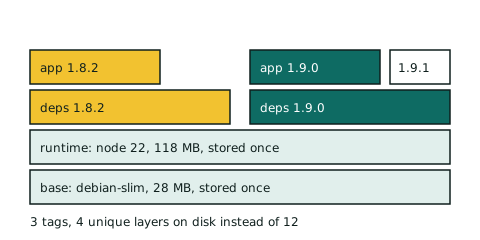
A typical service image has a 28 MB base, a 118 MB runtime and a few small layers of your own code. Push forty versions and Quayline still keeps one copy of the base and one of the runtime. Your storage bill follows what is actually different between builds, not how often you ship.
- Deduplication spans every repository in the organisation, not only one image name.
- Cross-repository blob mounts make a retag or promotion a metadata write that finishes in milliseconds.
- Pulls of a layer that any runner in the region fetched in the last hour come from the edge copy.
A CI cache that is part of the registry, not another service
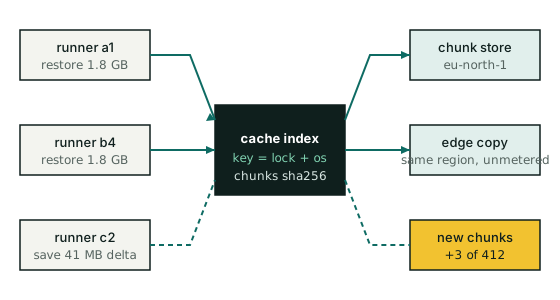
qln cache stores dependency directories, compiler output and test fixtures next to your artifacts, under the same tokens and the same retention rules. Restores from a runner in the same region are not metered against your egress pool.
$ qln cache restore --key "node-$(sha256sum pnpm-lock.yaml | cut -c1-12)" node_modules
# restored 1.8 GB from eu-north-1 in 6.2 s (412 chunks, 0 fetched cold)
$ qln cache save --key "node-$(sha256sum pnpm-lock.yaml | cut -c1-12)" node_modules
# 3 of 412 chunks were new: uploaded 41 MBRetention that you can read, review and dry-run
Policies are a file in your repository, applied hourly, with a seven-day window to restore anything a rule removed.
retention.yaml
# retention.yaml
version: 2
scope: tidewater/*
rules:
  - name: keep-releases
    match: { tag: "^v[0-9]+\\.[0-9]+\\.[0-9]+$" }
    keep: forever
  - name: branch-builds
    match: { tag: "^(main|dev)-[0-9a-f]{7}$" }
    keep: { last: 5, per: branch }
  - name: pull-requests
    match: { tag: "^pr-[0-9]+" }
    keep: { max_age: 14d }
  - name: untagged
    match: { untagged: true }
    keep: { max_age: 3d }
qln retention plan prints what would be removed and how many gigabytes it frees before anything changes. In a recent customer rollout a 61 TB organisation dropped to 9.4 TB without a single failed deploy, because protected tags and digests referenced by running clusters were excluded by rule.
Egress is pooled by seat, so heavy days average out
Build farms pull in bursts. A release day can move more data than the rest of the week. Pooling smooths that out.
- 1 TB
- of egress per seat each month on Team
- 5 TB
- of egress per seat each month on Scale
- 0 B
- charged for same-region cache restores and in-region mirror hits
A 40-seat engineering organisation on Scale gets 200 TB of pooled egress every month. Past the pool, Scale bills $0.010 per GB, about a fifth of what a general-purpose cloud charges to move the same bytes out. Starter, Team and Scale all show live usage in the console, and we alert at 70, 90 and 100 percent of the pool before anything is billed.
We moved 1,400 repositories and a 38 TB container archive in a long weekend. The first Monday build was 11 minutes faster because the cache and the images finally lived in the same place as the runners.
Shipped recently
Registry and CLI releases land every two weeks, with notes written by the engineers who built them.
- v2.14.3Fix for referrers listing on indexes with more than 500 children, faster qln login on slow DNS.
- v2.14.0Retention policy dry-runs in the console, per-repository egress charts, SCIM group sync for Scale.
- v2.13.0Maven virtual repositories, resumable generic uploads up to 200 GB, ap-northeast-1 storage cell.
- v2.12.0OIDC workload identity for CI, cosign signature policies, audit log export to object storage.